

01
Development
Innovative Development
Unlock deeper insights into your procurement process, revealing opportunities for optimization and risk mitigation that transcend mere transactions.
.png)
Unlock deeper insights into your procurement process, revealing opportunities for optimization and risk mitigation that transcend mere transactions.
Streamline your procurement cycle with smart, data-driven decisions that boost efficiency, reduce costs, and enhance supplier relationships.


.png)

Step into a new era of procurement where advanced analytics and predictive monitoring pave the way for a secure, transparent, and fraud-free operation.
Our iRM team has revolutionized the procurement process by addressing the challenges of internal fraud and inefficiency that plague organizations. By harnessing the power of data extraction scripts tailored for leading ERPs like SAP and Oracle, we've streamlined the extraction of comprehensive procurement data. Our approach utilizes machine learning to analyze the median processing time across procurement stages, such as the transition from purchase requisition to purchase order, especially focusing on specific item categories. This analysis, grounded in the principles of the Gaussian distribution, enables us to identify high-risk transactions swiftly and with precision. Our solution empowers business users with detailed, actionable insights, enabling them to uncover and investigate potentially fraudulent activities efficiently, thereby safeguarding organizational resources.
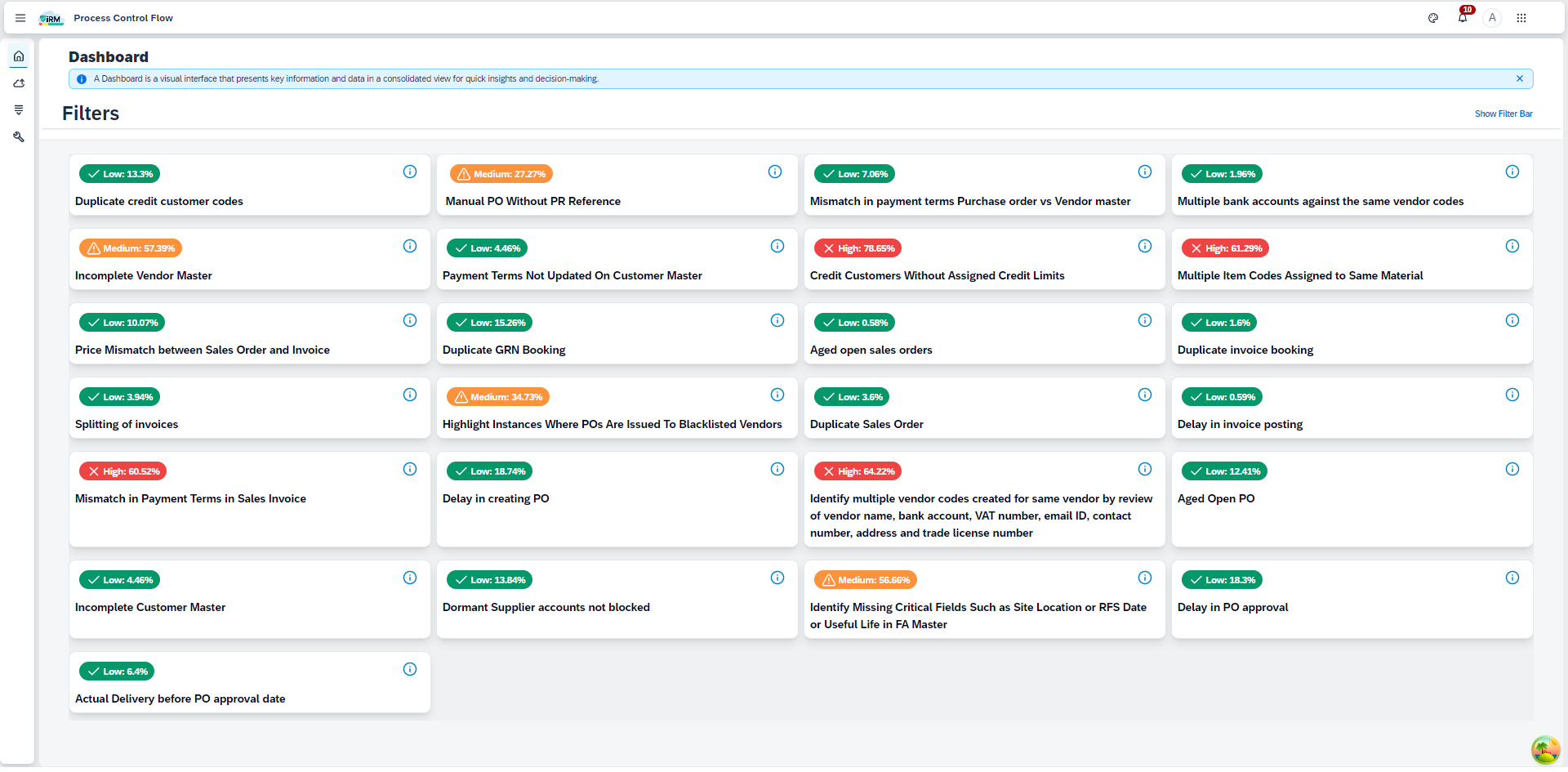
The Process Control Flow application is an advanced business tool designed to conduct detailed detective analysis across two critical business processes: "Order to Cash" (O2C) and "Procure to Pay" (P2P). The application focuses on ensuring that all control measures within these processes are functioning correctly by identifying and analyzing violations based on historical data. These violations indicate areas where the actual business operations deviate from the expected norms, potentially leading to financial discrepancies, operational inefficiencies, or compliance issues.
1. Order to Cash (O2C) Process: The "Order to Cash" process encompasses all steps from receiving a customer order to collecting payment. The application monitors this process to detect and report violations, ensuring that each step, from order entry to invoicing and payment collection, adheres to the set controls.
✔ Price Mismatch Between Sales Order and Invoice: This violation occurs when there is a discrepancy between the price agreed upon in the sales order and the price billed in the invoice. Such mismatches can result in revenue loss, customer dissatisfaction, and accounting inaccuracies. The application analyzes historical sales orders and corresponding invoices to identify and report any deviations.
✔ Duplicate Credit Customer Codes: In the O2C process, each customer is assigned a unique credit customer code for credit management purposes. The application detects instances where the same customer code is used for multiple customers or where a customer has been assigned multiple codes. This ensures the accuracy of customer credit limits and prevents potential fraud or credit mismanagement.
✔ Duplicate Invoice Booking: This violation occurs when an invoice is recorded more than once in the system, leading to inflated revenue figures and potential audit issues. The application identifies and flags such instances by comparing invoice numbers, dates, and amounts, ensuring that each invoice is unique and correctly recorded.2.
2. Procure to Pay (P2P) Process: The "Procure to Pay" process covers the entire lifecycle from procuring goods or services to payment to suppliers. The application ensures that this process operates smoothly and according to the defined controls.
✔ Multiple Item Codes Assigned to the Same Material: In the P2P process, it’s critical that each material is consistently identified with a single item code. The application identifies cases where multiple item codes have been assigned to the same material, which can cause errors in inventory tracking, procurement, and cost management. By detecting these inconsistencies, the application helps maintain accurate inventory records and ensures that procurement activities are correctly aligned.
✔Duplicate Invoice Booking in P2P: Similar to the O2C process, duplicate invoice booking is a critical issue in P2P. When a supplier's invoice is recorded multiple times, it can lead to overpayment and reconciliation issues. The application detects such duplicates by analyzing invoice data and cross-referencing it with purchase orders and goods receipts, ensuring that each payment is accurately processed.
3. Reports and Compliance: The application generates detailed reports that provide insights into the detected violations within both the O2C and P2P processes. These reports are essential for business leaders and compliance officers to take corrective actions and implement preventive measures. They include:
✔ Violation Summary: A high-level overview of the types and frequencies of violations detected, categorized by business process and control type.
✔Detailed Analysis: In-depth analysis of each violation, including data points such as affected transactions, financial impact, and potential root causes.
✔Compliance Recommendations: Suggested actions for rectifying identified issues and enhancing control measures to prevent future violations.

%201%201.png)
✔ Enhanced Fraud Detection: By pinpointing transactions that significantly deviate from established norms, the solution provides an early warning system for potential fraud and collusion, enabling proactive measures to mitigate risks and prevent financial losses.
✔Improved Process Efficiency: Identifying unusually quick transactions not only flags potential risks but also highlights areas where the procurement process may be optimized without compromising on due diligence. This leads to more efficient operations and can help in capturing early payment discounts and improving supplier relationships.
✔ Data-Driven Decision Making: With actionable insights derived from machine learning and statistical analysis, organizations can make informed decisions to streamline procurement processes. This empowers leaders to base their strategies on solid data, enhancing transparency and accountability across departments.
✔ Increased Compliance and Control: The solution strengthens compliance with internal controls and external regulations by ensuring that all transactions undergo the appropriate levels of scrutiny. This is particularly crucial in highly regulated industries or sectors where procurement integrity is under close watch.

The primary objective of the iRM team's approach is to address and mitigate internal fraud and inefficiency within organizations. By using data extraction scripts for ERPs like SAP and Oracle and applying machine learning for analyzing procurement data, the team aims to identify high-risk transactions and provide actionable insights for uncovering and investigating potential fraud, thereby protecting organizational resources.
The solution supports data-driven decision-making by providing insights derived from machine learning and statistical analysis of procurement data. This empowers organizational leaders to make informed decisions based on solid data, enhancing transparency and accountability across departments. It allows for the optimization of procurement processes and strategies based on analytical evidence rather than intuition or assumption.
The Rapid Transaction Detection feature employs specialized algorithms to flag transactions that are completed significantly faster than established norms. This helps in highlighting procurements that may have bypassed typical due diligence processes, signalling potential risks or inefficiencies. It serves as an early detection system to identify and address procurements that might compromise the process's integrity or efficiency.
The tool simplifies procurement by enabling easy analysis of flagged transactions, helping users to quickly grasp each case's specifics and track ongoing patterns. Essential for maintaining audit records and regular oversight, it significantly aids in refining procurement strategies, ensuring transparent and well-informed decisions.


